 Olivia Florio Roberts ( Florida )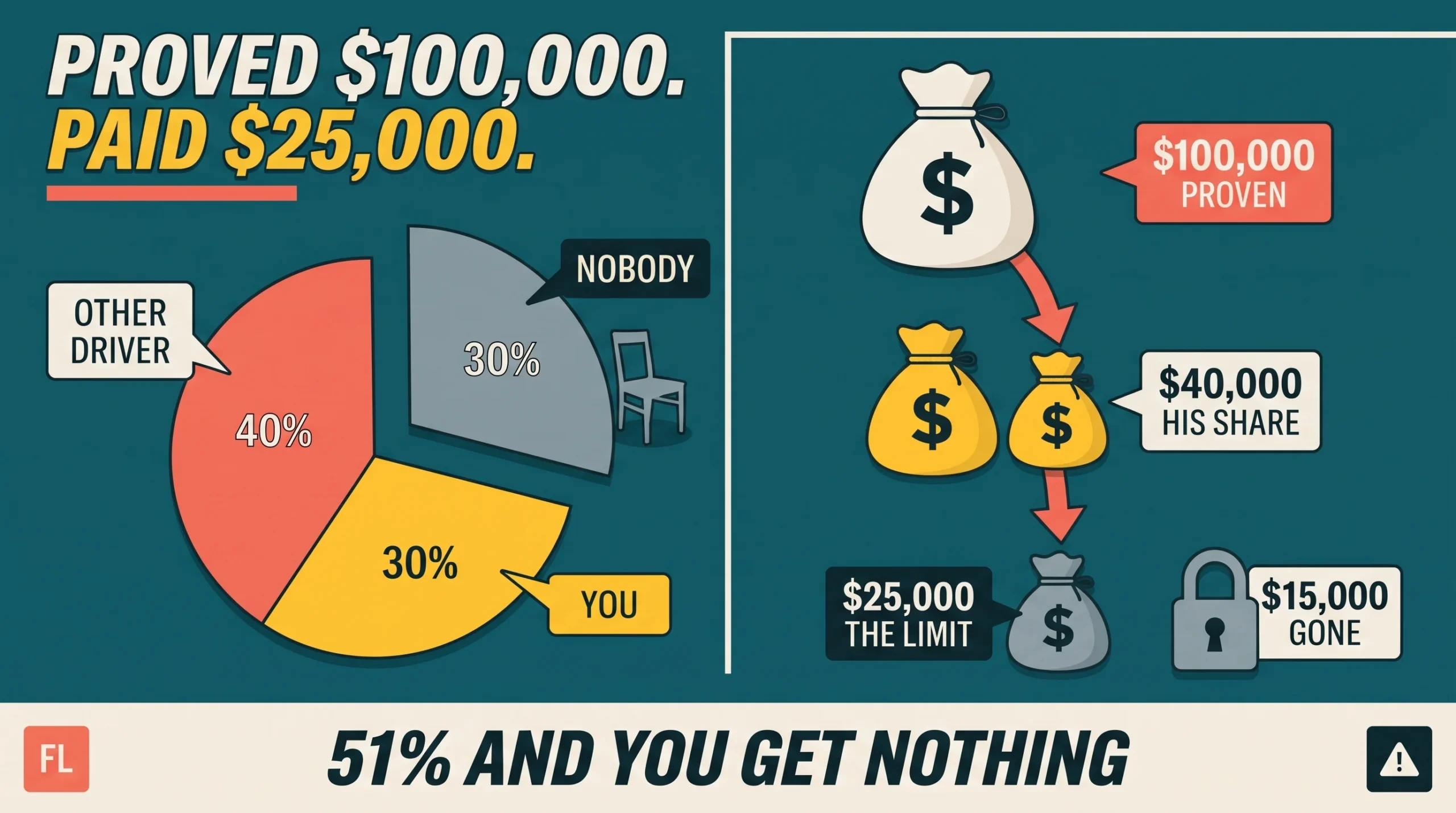
Somebody hit you, you were partly in the wrong and the adjuster has now written to tell you what your share of the blame comes to. In Florida that letter matters more than the crash report, more than the citation, more than who looked worse at the scene, because since March 2023 the state has used a rule under which a share of 50 percent or lower still gets paid, reduced and anything from 51 upward gets nothing. So the whole claim rides on a number somebody else picked.
What the letter will not have told you:
- The number does not have to add up between the two drivers. A third party who was never sued and in a lot of Miami cases never found, can be given a slice by the jury and that slice comes out of your money.
- Each driver pays only their own slice. Florida got rid of joint liability in 2006, so a driver with insurance does not get made to cover the share of a driver without any.
- Whatever you told the officer at the scene stays out of a civil case by statute, though the recorded call with the insurer has no such protection.
Bird Road, A Left Turn And A Van That Kept Going
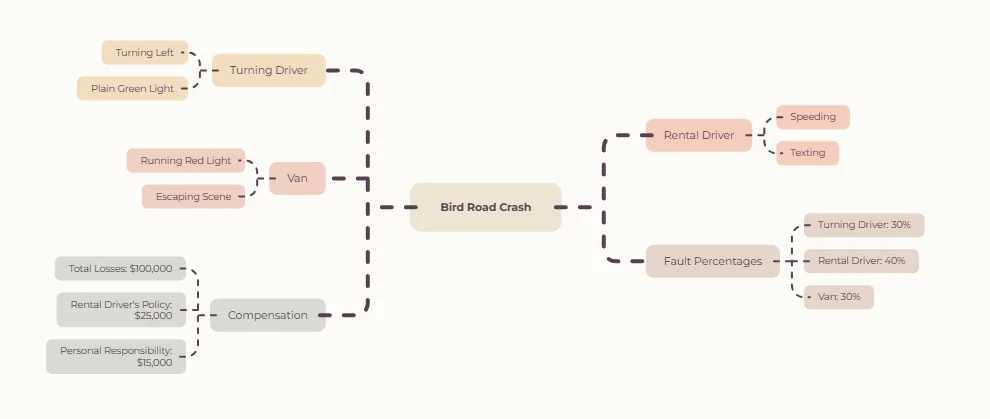
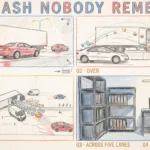
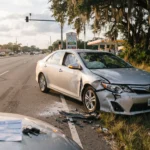
Take a crash that gets handled in Miami-Dade every week of the year. A woman turning left off Bird Road onto SW 87th on a plain green, no arrow. Oncoming rental, driven by someone down from New York for a wedding, doing more than the posted 40. A second before that, a white cargo van had run the red across the same intersection and carried on toward the Palmetto. The rental caught her in the passenger door.
She had a broken wrist and a knee that later needed surgery. Bills, six weeks off work and the pain on top came to a proven $100,000. She gave the rental company’s insurer a recorded statement on day four and said she “thought she had time”.
The insurer’s first letter put her at 60 percent. Turning across traffic. Under the 2023 rule 60 means zero, which the adjuster knew when he picked it.
Then her lawyer got involved.
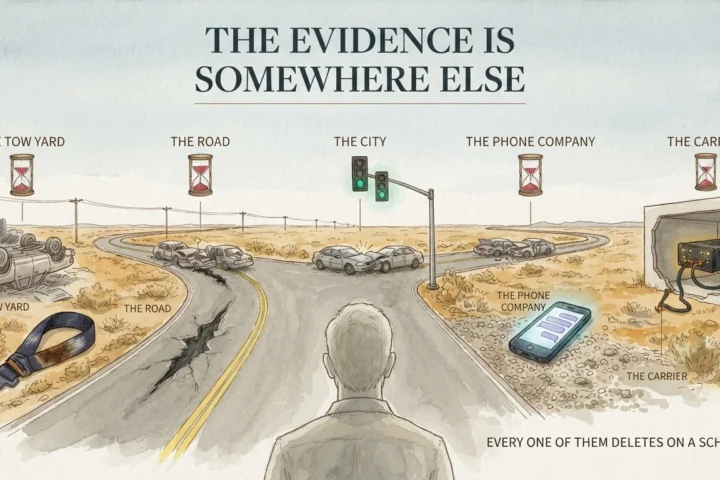
- He got the county’s intersection camera, which holds video for about a month and it had the van running the red and the rental doing roughly 55.
- Phone records on the rental driver, subpoenaed after suit was filed, showed a text sent nine seconds before the impact.
- The rental driver’s own lawyer then filed an answer naming the van as a non-party at fault. That helped her less than it sounds.
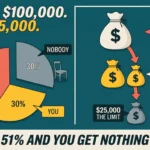
- The percentages, when the case was finally valued:
- the turning driver, 30 percent
- the rental driver, 40 percent
- the van, 30 percent
- What that did to the $100,000:
- her own 30 percent lopped off first, leaving $70,000 in theory
- the rental driver owes her 40 percent share only, $40,000
- the van’s 30 percent, $30,000, owed by no one who can be sued
- What the rental driver’s policy could pay: $25,000, its bodily injury limit. The remaining $15,000 of her share sits with her personally, or with the turning driver’s own uninsured motorist coverage, if she had bought any.
So a driver with $100,000 in proven losses and a fault share safely under the line ended up with $25,000 from the other side and each cut along the way had come from a percentage, never from any doubt about her injuries.
Nothing in that case would surprise a Miami adjuster except the van turning up on camera.
Where The Percentages Come From: Section 768.81
The two subsections of Florida’s comparative fault statute at work in that case were written seventeen years apart.
Subsection (6) came in with HB 837 in March 2023. Fault over 50 percent, no recovery. Fault at 50 or under, recovery reduced by that share. Before that date Florida had been pure comparative for fifty years, meaning a driver 80 percent at fault could still collect 20 percent, so most of what you will read online about Florida fault and whatever an older relative remembers about it, describes a rule that has gone.
Subsection (3) dates from 2006. It ended joint and several liability, meaning each defendant is on the hook for its own percentage and no more and it also lets a defendant plead that somebody who is not in the case was at fault too. The jury then puts that somebody on the verdict form beside the actual parties.
The Fabre Defendant
The absent party has a name in Florida practice. It is a Fabre defendant, after Fabre v. Marin, 623 So. 2d 1182 (Fla. 1993), where the Florida Supreme Court held that a jury has to apportion fault among everyone who contributed to the injury, whether or not they were sued. Three years later, in Nash v. Wells Fargo Guard Services, 678 So. 2d 1262 (Fla. 1996), the court put a condition on it: the defendant has to plead the non-party as an affirmative defense and identify them as specifically as it can. A van with no plate can be pleaded and so can a phantom vehicle, a county that timed its signal badly, a bar that over-served the other driver, an employer or a road contractor, provided the defendant names them in its answer and then proves their fault at trial.
The reader’s job is to read the answer. That document, filed by the other driver’s lawyer a few weeks into the suit, is where the empty chair first appears and once it has appeared the fault pie has three slices instead of two. Some of the slice given to the van would otherwise have gone to the rental driver. Some of it, though, would otherwise have been argued onto the claimant and this surprises people: a Fabre defendant can lower your own percentage as well as the defendant’s.
Section 316.066(4), Which Most Drivers Have Never Heard Of
What the turning driver said to the officer at the scene, for the purpose of the crash report, was privileged. The statute says such a statement may not be used as evidence in any trial, civil or criminal. The officer’s narrative, the diagram, the box she ticked, none of it comes in against her.
The recorded statement to the insurer four days later had no protection at all and the 60 percent came far more out of “I thought I had time” than out of the left turn itself.
| Your share of fault | On $100,000 in proven damages | Rule doing it |
| 20 percent | $80,000 recoverable | Reduced by your share, 768.81(6) |
| 50 percent | $50,000 recoverable | On the line, still recoverable |
| 51 percent | $0 | Barred, 768.81(6) |
| 30 percent, with 30 given to an absent van | $40,000 owed by the other driver, $30,000 owed by no one | Fabre share plus several liability, 768.81(3) |
- The biggest single loss in a shared-fault claim is usually the slice handed to somebody who was never in the room.
The Adjuster Sets The First Number, Inside A Week
Not the officer. Florida’s crash report does not fix civil liability and an officer who writes “vehicle 1 failed to yield” has handed the insurer an opening and nothing more.
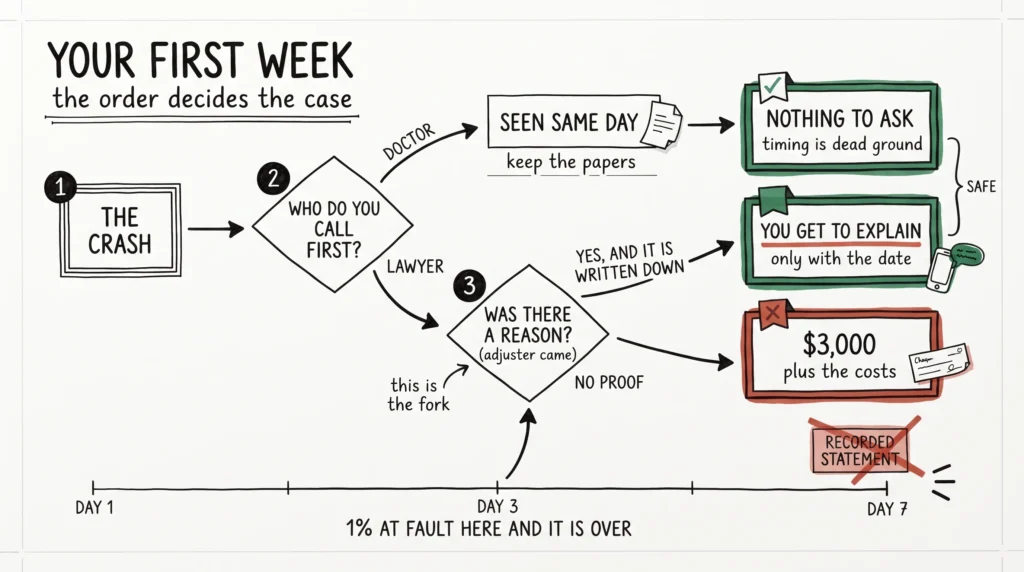
The first percentage anybody puts on paper is the adjuster’s and it comes out of the recorded statement. That call usually happens inside a week, before the claimant has seen the report, before any camera footage has been asked for, while she is still on painkillers. The adjuster is not being underhand. He has a file to close and the only account of the crash he has is hers.
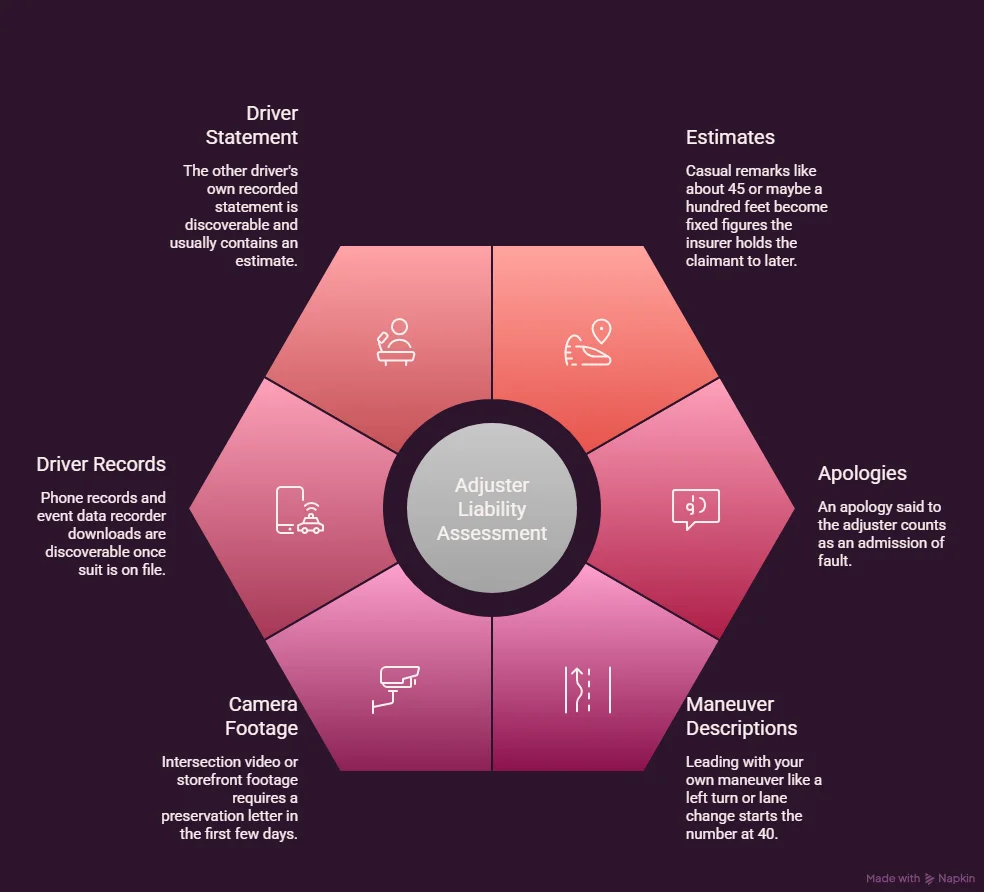
On that call, these turn into percentage points:
- Estimates go straight in. “About 45”, “maybe a hundred feet”, “I looked but I didn’t see him” each become a figure the insurer holds the claimant to later.
- An apology said to the adjuster counts as an admission, although the same words to the officer would have stayed out under 316.066(4).
- Any description of your own maneuver before the other driver’s. Left turn, lane change, following distance. Lead with those and the number starts at 40 before anyone mentions the other car’s speed.
Getting the number moved back takes longer and needs:
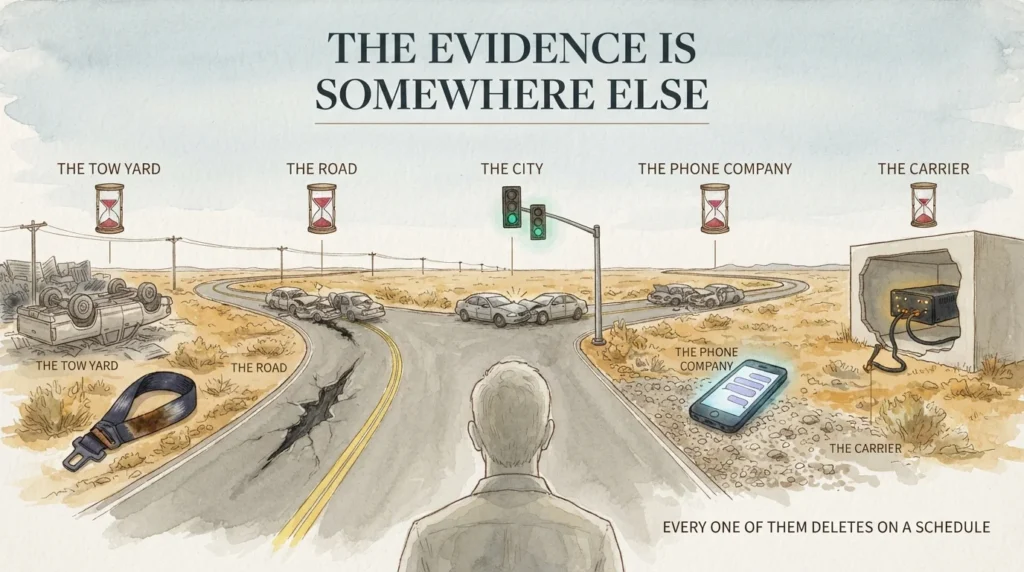
- Camera footage. Miami-Dade traffic engineering keeps intersection video for roughly 30 days; storefronts on Bird Road, more like a week. so a preservation letter has to go out in the first few days.
- The other driver’s phone records and event data recorder download, both discoverable once suit is on file.
- The other driver’s own recorded statement, which is discoverable too and usually contains an estimate of its own.
Most of the fault number gets set in the first two weeks out of the claimant’s own mouth and moving it afterward means going out and getting evidence the insurer will never volunteer.
Visitors Are On The Wrong Rulebook
Miami-Dade’s 2023 numbers, from the FLHSMV dashboard:
- 64,009 crashes, around 175 a day
- 29,816 people hurt
- 325 killed, in 310 fatal crashes
- roughly 15 percent of every crash in Florida, from one county out of 67
A good share of the drivers in those numbers learned to drive somewhere with a different fault rule.
A crash on a Miami road is judged by Florida law wherever the driver lives, whatever plate the car carries. Four different rules exist in this country and Florida moved between them recently enough that even locals still carry the old rule around.
| Rule | What it means for a driver partly at fault | Where |
| Pure comparative | Recover your share at any percentage; 90 percent at fault still gets 10 percent | New York, California, about eleven others |
| Modified, 50 percent bar | Recover at 50 or under; nothing at 51 | Florida since March 2023, Georgia, about ten others |
| Modified, 51 percent bar | Recover only if your fault is below the other side’s; nothing at 50 | Texas, Illinois, about twenty others |
| Pure contributory | Any fault at all, nothing | Alabama, Maryland, North Carolina, Virginia, DC |
The New Yorker in the rental above would have collected 40 percent of his own damages at 60 percent fault at home. On the Palmetto, 60 gets him nothing. A Marylander who knows that 5 percent fault ends a claim in Baltimore is, for once, better off here.
The Miami car accident attorney page over at Blakeley gives the 20 percent example and the 51 percent cut-off in a couple of lines and names the Palmetto, US-1 and Biscayne as the roads where it sees most of these, which lines up with the county’s own crash map. The empty chair gets no space on a practice page, which is a pity, because shared-fault claims in Miami come apart on that slice far more often than on the 50 line and the driver holding it is usually one no one will ever find.
Why Uninsured Motorist Cover Does More Work Here Than In New York
Florida does not make drivers buy bodily injury liability coverage. None. The state minimum is $10,000 of personal injury protection, which pays your own medical bills and lost wages whoever was at fault and $10,000 of property damage liability for the other person’s car. A driver can be on the road legally with nothing at all to pay a 40 percent share from.
To claim against the other driver for pain and suffering at all, your injury has to clear section 627.737: permanent injury within a reasonable degree of medical probability, significant scarring or disfigurement, or death. The turning driver’s knee cleared it. Plenty of soft-tissue claims do not.
Put several liability and the missing bodily injury requirement together and you get the $15,000 hole in the case study. The rental driver’s 40 percent was real and the policy behind it stopped at $25,000. Uninsured and underinsured motorist coverage on the turning driver’s own policy, if she had bought it, would have paid the gap. In New York, where drivers have to carry $25,000 in bodily injury coverageage and a pure comparative rule lets the claimant collect from whoever is left, UM sits in the background. In Florida it is often what turns a percentage into a check at all.